Not Your Grandmother's Kitchen: Vietnamese American Chefs Who Cook Everything Except Vietnamese Food
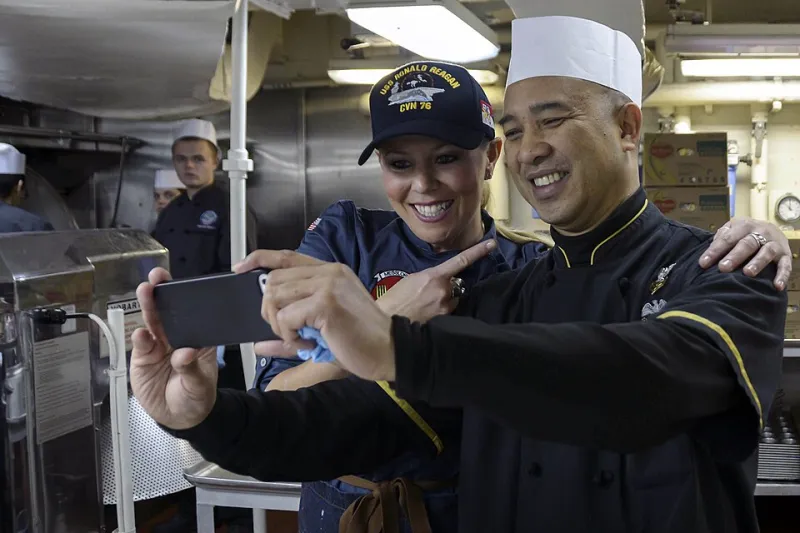
Photo: Official U.S. Navy Page from United States of America, Public domain, via Wikimedia Commons
The first thing Jade Vũ learned to cook well was pasta. Not phở. Not bún bò Huế. Pasta. Specifically, her college roommate's grandmother's Sunday gravy recipe, scrawled in blue ballpoint on a torn piece of notebook paper and taped inside a cabinet door in their shared apartment in Boston.
"I was obsessed," Jade says. "I made it every Sunday for a year. I called my roommate's grandmother twice to ask follow-up questions. I was more devoted to that sauce than I was to most of my coursework."
Jade is now a pastry chef in Chicago, specializing in French and Viennese techniques. Her Vietnamese heritage shows up occasionally — a pandan cream here, a lychee tart there — but Vietnamese food is not her lane, and she's spent years making peace with that.
"People find out I'm Vietnamese and they immediately ask if I make phở or bánh mì. And I get it. Those are the associations. But I don't, really. And that used to feel like a failure. Now it just feels like the truth."
The Expectation Nobody Says Out Loud
There's an unspoken logic that often follows Vietnamese American cooks into professional kitchens: you are the keeper of your culture's food. Your heritage is your specialty. Your identity is your brand.
It's a logic that makes sense on the surface. Vietnamese cuisine is extraordinary — complex, regional, layered with history. The world should know it better. And Vietnamese American chefs who champion it are doing genuinely important work.
But the expectation can become a kind of box. And not everyone wants to live inside it.
Daniel Phan runs a small but acclaimed catering operation in the Washington, D.C. area focused on West African-inspired cuisine — Senegalese thiéboudienne, Ghanaian jollof variations, Nigerian suya. He got into this food after a semester abroad in Dakar during college and never really got out.
"I fell in love," he says simply. "The spices, the communal cooking, the way food was tied to hospitality and ritual — it reminded me of something, actually. It reminded me of my family's relationship to food. Just through a completely different culture."
His Vietnamese family was, in his words, "confused but supportive." His mother's main concern was whether he was making enough money. His grandfather asked once, with genuine curiosity, why he didn't just cook Vietnamese food instead. Daniel didn't have a clean answer.
"How do you explain that your culinary soul went somewhere unexpected? That love isn't always logical?"
Authenticity and Who Gets to Define It
The question of authenticity haunts this conversation from every direction. There's the external pressure — customers, food media, well-meaning strangers who want Vietnamese American chefs to be ambassadors of a specific tradition. And then there's the internal one, the voice that wonders whether stepping away from your heritage's food is a kind of betrayal.
Anna Lương, a home cook in Los Angeles who has built a following on social media for her elaborate Japanese home cooking, has felt both pressures acutely.
"I grew up eating my mom's Vietnamese cooking every night. It's in my bones. But Japanese food was the thing I chose for myself, as an adult, independently," she says. "And there's something about that — the choosing — that feels important to who I am now."
She still cooks Vietnamese food. She makes her mother's caramelized fish for comfort. But her creative energy, her experimentation, her joy — that lives in Japanese cuisine right now.
"Some of my followers get weird about it. Like I'm supposed to be a Vietnamese food account," she says. "But I never said I was. I just said I was someone who loves to cook."
Chef and food writer Tâm Hoàng, who writes about Vietnamese diaspora food culture, thinks the pressure on Vietnamese American cooks to stay in their lane reflects something larger.
"We want our food represented. We want our culture visible. And sometimes we unconsciously deputize individual chefs to do that work," she says. "But that puts an unfair burden on people who are just trying to cook what they love. A white chef who loves Vietnamese food doesn't get asked why they aren't cooking French food instead. The standard is applied unevenly."
What Home Cooking Actually Looks Like
For many Vietnamese Americans who cook outside their heritage, the relationship to Vietnamese food hasn't disappeared — it's just complicated.
Jade Vũ still eats phở when she's sick. She still makes her mother's gỏi cuốn for Tết gatherings because not doing so would feel like a small erasure. But it's not where her creativity lives, and she's stopped apologizing for that.
"I think for a long time I thought my Vietnamese-ness had to show up in my cooking," she says. "But it shows up in how I work. The discipline, the attention to detail, the way I think about feeding people as an act of care. That's all my mother. That's all my culture. It just comes out through croissants."
Daniel Phan has a similar take. "My Vietnamese identity isn't diminished because I cook Senegalese food. If anything, my background gives me a sensitivity to what it means when food carries culture. I bring that to everything I make."
There's something quietly radical in that reframing. The idea that cultural identity isn't a recipe — that it's a way of moving through the world, a set of values and relationships and memories that travel with you into whatever kitchen you happen to be standing in.
The Freedom in the Choosing
What strikes you, talking to these cooks, is how much joy lives in their stories. Not the anxious joy of someone performing happiness, but the real thing — the kind that comes from doing exactly what you love without waiting for permission.
Anna Lương is currently deep in a project recreating regional Japanese home cooking styles she's been researching for two years. She films herself cooking in her small apartment kitchen, her Vietnamese American life visible in the background — family photos, a small altar, a jar of fish sauce on the counter.
"It's all there," she says, gesturing at the frame. "Everything that made me. I just happen to be making dashi right now."
Maybe that's the most honest thing about food and identity: it's never just one thing. The flavors you're born into and the ones you choose for yourself don't have to compete. They can simply coexist — each one real, each one yours.