Nobody Blew Out the Candles: Growing Up in a Family That Forgot to Celebrate You
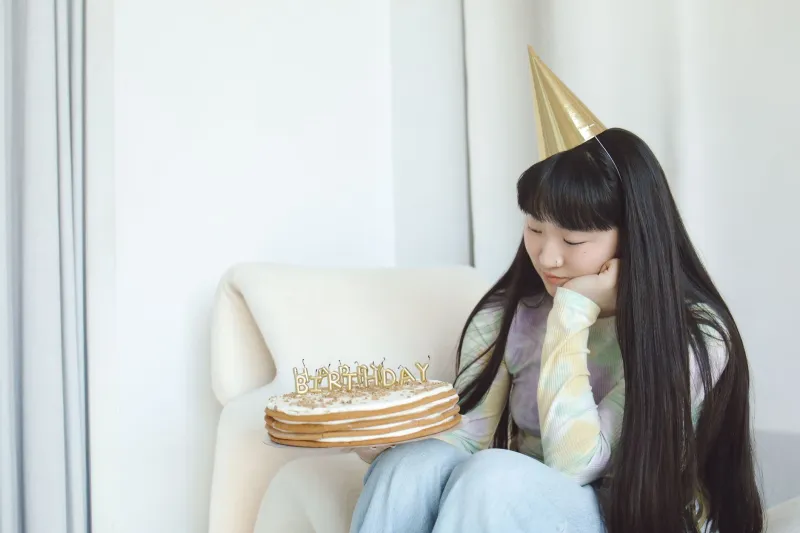
Thu Nguyen turned thirty-four last March. Her coworkers brought a grocery store cake to the office. Her friends texted. Her mom called — not to sing happy birthday, but to remind her about a cousin's wedding deposit that needed to go out before the weekend.
Thu laughed about it later. "It's not that she forgot," she told me. "It's that it genuinely didn't occur to her that the day was supposed to mean something."
For a lot of Vietnamese American families, birthdays exist somewhere between a footnote and an afterthought. Not out of neglect, exactly. Not even out of coldness. It's something older and more complicated than that.
The Calendar Was Always Full of Someone Else
Ask around in Vietnamese American communities and you'll hear the same story wearing different clothes. Birthdays growing up meant maybe a bowl of bún bò huế if you were lucky, a quiet acknowledgment at dinner, and the understanding that there were bigger things to worry about. Tet needed preparing for. A grandparent's death anniversary — giỗ — demanded real ceremony. A cousin's graduation, a uncle's retirement party, a neighbor's newborn: these were the occasions that pulled the whole family together.
Your birthday? That was personal. And personal, in many traditional Vietnamese households, wasn't really the point.
Cultural historian Linh Phạm, who teaches at a university in Southern California, puts it plainly: "Vietnamese family culture has always been organized around the collective. The individual exists in relation to the group — to ancestors, to living family, to community. A birthday is one person's day. That framing just wasn't built into the architecture."
There's also the shadow of survival. Parents who fled Vietnam in the late seventies and eighties, who rebuilt lives from nothing in places like Garden Grove, Little Saigon, or Dorchester, were often operating in pure endurance mode for years. Cake felt frivolous when the electricity bill was late. Celebration felt like tempting fate when everything was still so fragile.
What Gets Lost in the Silence
Here's the part that's harder to talk about: the kids who grew up in those houses didn't always understand the why. They just felt the absence.
Michael Trần, now thirty-one and living in Houston, remembers watching his classmates get picked up from school on their birthdays with balloons tied to their backpacks. "I used to tell myself it was dumb," he says. "That it was wasteful, or that American families were just extra. But honestly? I wanted it. I wanted someone to make a big deal out of me existing for one day."
That gap — between the cultural logic of the parents and the emotional experience of the child — is exactly where a lot of Vietnamese Americans are sitting right now, sorting through complicated feelings in their twenties, thirties, and forties. Therapists who work with this community report that the birthday question comes up more than you'd expect. Not always as the central wound, but as a symbol. A stand-in for a larger question: Was I seen?
"It's rarely really about the birthday," says a licensed therapist in the Bay Area who works primarily with second-generation Asian Americans. "It's about whether someone tracked you as an individual. Whether your presence in the world was something worth marking."
A Generation Pushing Back — Gently
What's interesting is how Vietnamese Americans are responding. Not with bitterness, mostly. Not with the kind of dramatic break from family that older generations might have feared. Instead, it looks more like a quiet insistence. A gentle reclamation.
Anna Lê, twenty-eight, started a new tradition with her family two years ago. She sends a group text a month before her birthday with a dinner restaurant already picked out. "I don't ask if they want to come," she laughs. "I just say, 'We're doing this.' My mom grumbled the first time. Now she's the one who makes sure everyone shows up."
For others, the shift is more internal. Kevin Võ, thirty-six, stopped waiting for his family to initiate and started celebrating himself — solo trips, a nice dinner with friends, a day off work just because. "I used to feel guilty about it, like I was being selfish," he says. "Now I think of it as modeling something. Teaching my own kids that their existence is worth celebrating."
That word — modeling — keeps coming up. This generation seems acutely aware that they are writing new scripts, not just for themselves, but for the children who are watching.
The Parents Aren't Villains in This Story
It would be easy to frame this as a simple failure. Parents who didn't show up, kids who were shortchanged. But that's not really what's happening here.
Many Vietnamese American adults, when they sit with it long enough, arrive at something softer. An understanding that their parents showed love in the ways they knew how — through sacrifice, through showing up to every school performance even exhausted, through working doubles so the rent was paid. The birthday cake wasn't there, but something else was.
Thu, from the beginning of this story, has been doing her own version of that reckoning. "My mom worked the night shift for years so I could go to a good school," she says. "She didn't sing to me on my birthday. But she was also the one who drove me to every single college interview. I don't think she didn't love me. I think she just didn't have a language for the other kind of showing up."
Now Thu is learning that language herself. She started small — a birthday dinner with close friends, no apologies for taking up space. Last year, she bought herself a cake and ate it alone on her couch watching a show she loved. "It sounds pathetic when I say it out loud," she admits. "But it was actually kind of beautiful. I was like, you made it another year. That matters."
Rewriting the Ritual
There's something deeply Vietnamese about this, actually — the idea that we carry forward what serves us and quietly release what doesn't. That traditions aren't fixed, but living. That honoring your ancestors doesn't mean you can't also honor yourself.
The Vietnamese Americans redefining how they mark their own milestones aren't abandoning their culture. They're expanding it. Making room inside it for individual joy alongside collective duty. Deciding that blowing out candles and calling your mom on giỗ can both be true.
You can hold the whole family together and still take up space as yourself. You can respect everything your parents carried and still say: my birthday matters too.
Maybe nobody told you that growing up. But somebody's telling you now.