The Slow Drip: How Vietnamese Coffee Became an Act of Remembrance
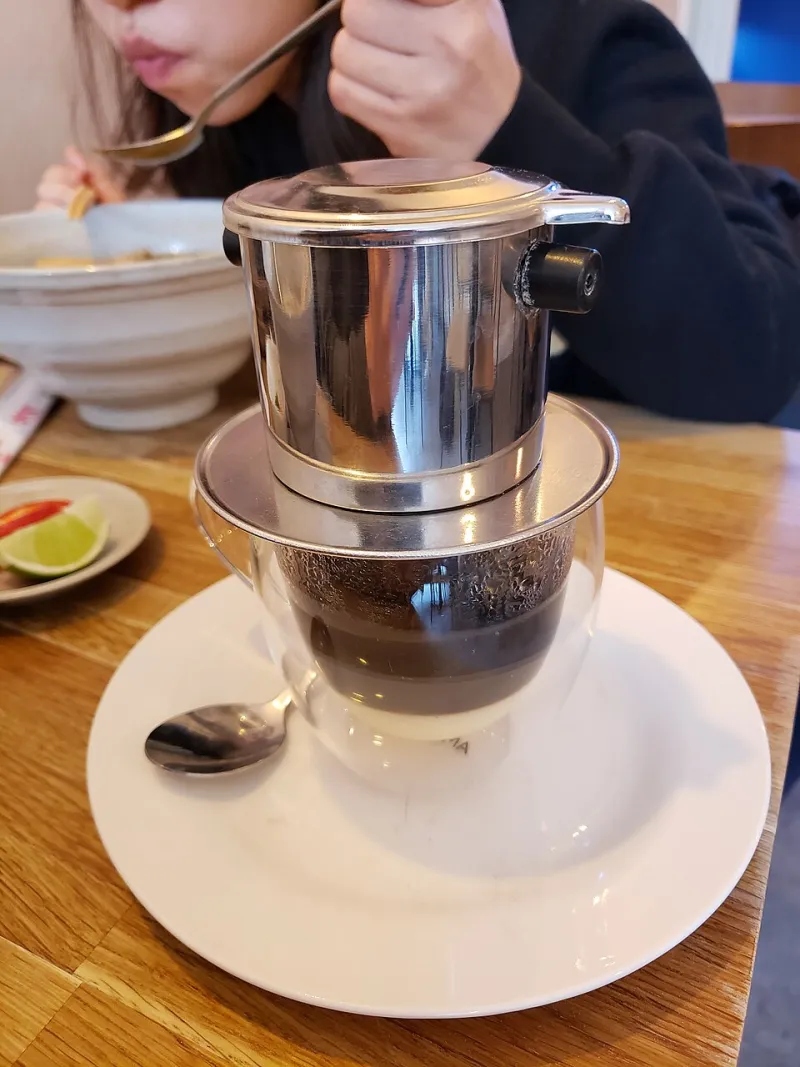
Photo: Andy Li, CC0, via Wikimedia Commons
Let me tell you about a Tuesday morning in a strip mall in Westminster, California.
It's 7:30 a.m. The parking lot is half-empty. Inside a small café called Cà Phê Sài Gòn, an older Vietnamese man sits alone at a laminate table. In front of him is a glass with a thin layer of sweetened condensed milk at the bottom. On top of the glass sits a small aluminum filter—a phin—packed with dark-roasted Vietnamese coffee. He is not looking at his phone. He is not reading anything. He is watching the coffee drip.
One drop. A pause. Another drop.
He has been doing this every morning for thirty years. He will do it again tomorrow.
This is Vietnamese coffee culture. And in America, it's becoming something quietly profound.
A Filter, a Glass, and Forty Years of History
The phin filter is deceptively simple—a small metal cup with a perforated base that sits on top of a glass. You add coarsely ground coffee, pour hot water, press a lid on top, and wait. The whole process takes about four to five minutes. You cannot rush it. That's not a bug; it's the feature.
Vietnam's coffee culture has French colonial roots—the French introduced coffee cultivation to Vietnam in the 19th century—but Vietnamese people made it entirely their own. They developed a preference for robusta beans, which are bolder and more caffeinated than the arabica varieties popular in the West. They added sweetened condensed milk because fresh dairy was scarce. They served it over ice in the brutal southern heat, creating cà phê sữa đá, one of the most satisfying cold drinks on the planet.
But beyond the recipe, they built a culture around it. In Hanoi, sidewalk cafés serve coffee in small ceramic cups, and you sit on tiny plastic stools for hours. In Saigon, the cafés are louder, more social, often spilling onto the street. In the central highlands—Đà Lạt, Buôn Ma Thuột—coffee is grown in the mist and drunk in the cool morning air with an almost reverent slowness.
When Vietnamese refugees and immigrants arrived in the United States in the 1970s, 80s, and 90s, they brought the phin with them. It was small enough to pack. It cost almost nothing. And every morning, it could conjure, for a few minutes, the feeling of home.
The Ritual as Anchor
Thúy Võ has owned a Vietnamese café in Houston's Midtown neighborhood for eleven years. She came to the US from Đà Nẵng in her late twenties and says the hardest part of early immigrant life wasn't the language barrier or the work—it was the formlessness of American mornings.
"In Vietnam, the morning has a shape," she explains, gesturing around her café, which smells of dark roast and condensed milk. "You wake up, you go to the corner, you have your coffee, you talk to people, you watch the street wake up. Here, everyone is rushing. Everyone is in their car. The morning has no shape."
So she made one. She opened her café at 6 a.m. and started serving cà phê phin the traditional way—slow, unhurried, with a glass of iced water on the side. Her first regulars were older Vietnamese men and women from the neighborhood, many of them retirees who had been in the US for decades. They came not just for the coffee but for what it represented: a morning with a shape.
"They come in and they slow down," Thúy says. "That's the whole point."
Younger Generations Are Paying Attention
Here's something interesting happening in Vietnamese American communities right now: younger people are rediscovering the phin.
For a generation raised on Starbucks drive-throughs and cold brew subscriptions, the slow drip of the phin filter feels almost radical. It demands your attention. It won't let you multitask. It forces you to wait in a culture that has optimized waiting out of existence.
Jason Lê, 27, a graphic designer in Chicago, started making cà phê phin at home during the pandemic. His grandmother had given him her old filter before she passed away. He'd never used it.
"I finally looked up how to use it, and the first time I made it, I just stood there watching it drip," he says. "And I thought—this is what she did every morning. This exact thing. Same filter, same coffee, same waiting. It felt like... I don't know. Like I was borrowing her morning."
He now makes it every day. He calls it his "reset."
Coffee Shops as Community Architecture
Across the US, a new wave of Vietnamese-owned cafés is doing something more intentional than just serving good coffee. Places like Café Tám in San Jose, Nguyen Coffee Supply in Brooklyn, and Saigon Social in New York are building spaces that center Vietnamese coffee culture as a form of cultural preservation and community-making.
Nguyễn Sahra Nguyen, founder of Nguyen Coffee Supply—the first Vietnamese American specialty coffee company in the US—has spoken publicly about her mission to reframe Vietnamese coffee not as a novelty item but as a sophisticated, storied tradition worthy of the same reverence Americans give to Japanese pour-over or Italian espresso.
Her work, and the work of others like her, is part of a broader reclamation: Vietnamese Americans insisting that their food culture, their rituals, their slower ways of being in the morning, deserve space in American life.
What the Drip Is Really Saying
There's a mindfulness movement in America that's worth billions of dollars. Apps, retreats, breathing exercises, all of it designed to help people slow down and be present. Vietnamese coffee culture figured this out generations ago with a four-dollar aluminum filter and a bag of Trung Nguyên beans.
The phin doesn't ask you to meditate. It doesn't give you a guided breathing prompt. It just drips, slowly, one dark drop at a time, and in doing so, it asks you to stay. To not rush off. To be in the morning for a few minutes before the morning takes you.
For Vietnamese Americans carrying the weight of displacement, of cultural distance, of trying to hold onto something that keeps threatening to slip away, that small act of staying—of watching the coffee drip, of tasting something that tastes like before—is not a small thing at all.
It is, in its own quiet way, a homecoming.
What does your morning coffee ritual look like? Tell us about it—we're always listening at Hành Trình Tôi.