The Corner Booth That Hears Everything: Inside the Hidden Emotional Labor of Vietnamese Small Businesses
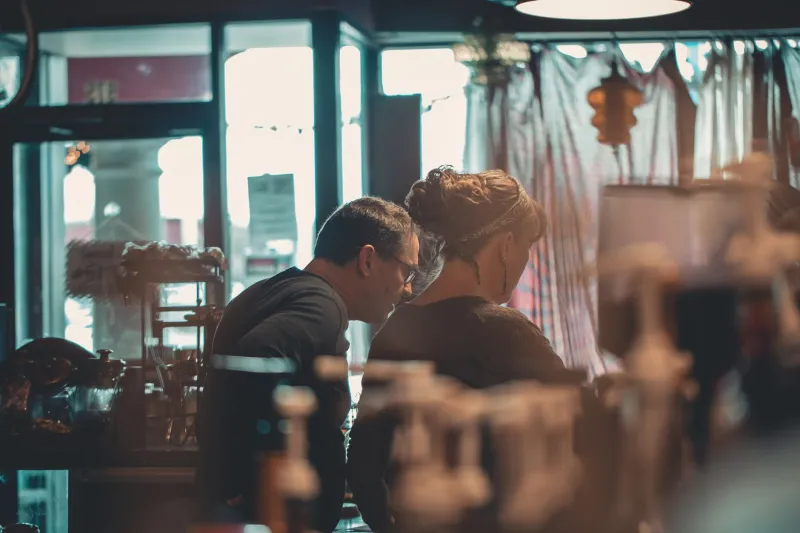
It started, for Linh, with a regular customer who came in every Sunday morning for phở.
She ran a small restaurant in a strip mall outside Houston — the kind of place with laminated menus and a fish tank by the door that had seen better days. The Sunday customer was a Vietnamese woman in her sixties, always alone, always ordered the same thing. One morning she sat down and just started crying. Not dramatically. Just quietly, the way older Vietnamese women sometimes do, like they've been holding something for so long that it finally found a crack to leak through.
Linh sat down across from her. She didn't know what else to do.
That woman came back the next Sunday, and the one after that. She started talking. Linh started listening. This went on for years.
"I never trained for this," Linh told me. "I trained for cooking. I didn't know I was also going to be... something else."
Why These Spaces Became Sanctuaries
Across the United States, Vietnamese-owned small businesses — restaurants, nail salons, bánh mì shops, the little grocery stores that smell like dried shrimp and fresh lemongrass — have quietly become something more than commercial spaces. They've become informal gathering places where people bring their real lives.
This isn't entirely accidental. These businesses are often embedded in communities in ways that larger corporate establishments simply aren't. The owners know their regulars by name, by order, by family situation. They remember who got divorced, whose kid got into college, who lost someone last winter. The relationship has texture and history.
For Vietnamese American customers especially, these spaces carry a particular kind of safety. You can speak the language here — or at least parts of it. You don't have to explain certain things. The food itself is a form of communication, a shorthand for shared experience.
When life gets hard, people go where they feel known.
The Confessional Dynamic
Nail salons might be the most underexamined social institution in Vietnamese American life.
Think about what happens in a nail salon: you sit still for an extended period of time, in close physical proximity to another person, in a context that's already intimate by nature. There's something about that stillness, that enforced pause, that loosens people up. Customers talk. And the nail technicians — many of them Vietnamese immigrant women who came up through the same economic precarity their customers may be navigating — listen.
They hear about bad marriages and difficult children. They hear about health scares and financial stress. They hear things that people probably haven't said out loud to anyone else.
"Sometimes I think people tell us things because we're safe," said one nail salon owner in Orange County who asked not to be named. "We're not in their social circle. We won't gossip to their friends. We're just... here."
There's a long tradition in many cultures of the service worker as confessor — the bartender, the hairdresser, the taxi driver. Vietnamese small business owners have stepped into this role in their communities, often without choosing it.
What It Costs the People Who Listen
Here is where the story gets more complicated.
Emotional labor is real labor. Therapists train for years to hold space for other people's pain without absorbing it. They have supervision, peer support, structured boundaries. Small business owners have none of that infrastructure.
Many Vietnamese restaurant and salon owners are themselves carrying significant weight — immigration trauma, financial stress, the particular exhaustion of running a small business in America where the margins are thin and the hours are long. And yet they absorb their customers' pain on top of their own, often because saying no feels culturally impossible.
Refusing to engage, redirecting a conversation, setting a limit — these things can feel like a violation of the hospitality ethic that many Vietnamese business owners were raised with. You take care of people. You don't turn them away.
The result, for some owners, is a kind of cumulative emotional debt. They give and give without a clear mechanism for replenishment.
"I love my customers," Linh said. "But sometimes I go home and I have nothing left. My husband talks to me and I just stare. I used it all up at the restaurant."
The Unspoken Exchange
There's another dimension to this worth naming: the exchange isn't always one-directional.
For some Vietnamese small business owners, particularly those who are older or who arrived in the US with limited formal education, their businesses are also their primary social world. The relationships they build with regular customers are genuine and sustaining. The conversations — even the heavy ones — are a form of connection that they value.
"It's not just them needing me," said one phở shop owner in San Jose. "I need them too. When my husband died, my customers were the first ones at the door. They brought food. They sat with me. These are not just customers."
This is the complexity that gets lost when we frame small business owners purely as service providers. They are members of their communities in the deepest sense. The emotional exchange, lopsided as it sometimes is, flows both ways.
What We Owe These Spaces
The next time you walk into a Vietnamese restaurant or nail salon and the owner asks how you're doing, consider the possibility that they actually want to know — and that they've heard harder answers than whatever you're carrying today.
These businesses are doing something that no app, no delivery service, no corporate chain can replicate. They're offering presence. Continuity. A place where you are recognized as a person with a history.
That is worth something. It might be worth more than we've ever bothered to say out loud.