What My Mother Never Said and Always Meant: Decoding Love in a Vietnamese American Family
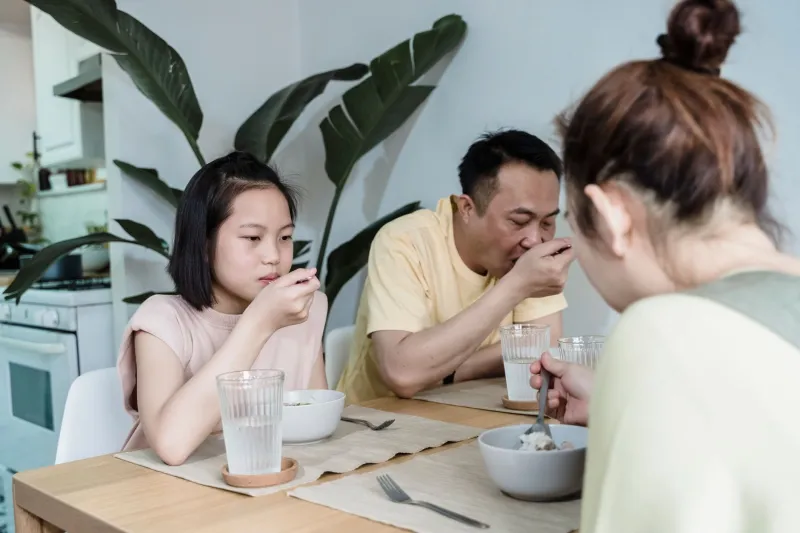
There's a running joke among Vietnamese American friends of mine that the closest thing to "I love you" you'll ever get from a Vietnamese parent is "Ăn cơm chưa?" — Have you eaten yet? And every time someone makes that joke, the laughter in the room has this particular texture to it. Not just funny. Recognized. A little tender around the edges.
Because it's true. And once you really sit with it, it stops being funny and starts being something else entirely.
The Words That Were Never the Point
Growing up in a Vietnamese American household in the suburbs of Houston, I cannot recall a single time my father looked me in the eye and said he loved me. Not once. And I spent a long stretch of my twenties believing that meant something was missing — that there was a gap in our relationship shaped exactly like those three English words.
What I didn't understand then, and what took me embarrassingly long to figure out, was that my father had been saying it constantly. Just not in any language I'd been taught to recognize.
He said it when he drove forty minutes to bring me bánh mì from the one bakery he trusted, the morning after I bombed a job interview. He said it when he showed up at my apartment with a bag of groceries I hadn't asked for, quietly restocking my fridge without comment. He said it every time he slipped money into my hand at the end of a visit — not a lot, sometimes just twenty dollars — folded small, like a secret between us.
He was fluent in a dialect I hadn't studied yet.
Emotional Restraint Has a History
This isn't unique to my family, of course. Across Vietnamese American communities from San Jose to New Orleans, the same pattern repeats: parents who sacrificed enormously, who worked double shifts and skipped vacations and sent remittances back to Vietnam for decades, but who rarely — if ever — said the words their American-raised children were conditioned to need.
There are cultural reasons for this that go deeper than personality. Vietnamese communication has historically leaned toward indirectness, particularly in intimate relationships. Open declarations of emotion, especially between parents and children, can feel excessive — even destabilizing — within a cultural framework that values harmony and restraint. Emotional vulnerability expressed loudly is not a sign of closeness. Quiet, consistent action is.
And then there's the weight of history. Many Vietnamese immigrant parents carried trauma from the war, from displacement, from years of survival that left little room for softness. Naming love out loud may have felt like an exposure they couldn't afford. Showing it — through feeding, providing, protecting — was both safer and more certain.
The Translation Problem
The trouble is, the children of those parents grew up absorbing a different vocabulary. American culture — especially the version broadcast through every TV show, every school counselor's office, every friend's birthday card — said love was verbal. Love was expressed. Love was checked in on and communicated clearly.
So there's a generation of Vietnamese Americans who grew up fluent in English emotional language and nearly illiterate in their own family's dialect. They knew how to say "I love you" but didn't know how to receive the money pressed into their palm as the same thing. They wanted to hear the words and couldn't always feel the soup.
The disconnect created real pain. Therapy waiting rooms across this country hold Vietnamese American adults who spent years wondering why their parents felt distant, cold, withholding — when the truth was that their parents were pouring themselves out in a language nobody had translated for them.
Learning to Read Backwards
The shift, when it happens, tends to feel less like an epiphany and more like slowly adjusting to a new light. You start noticing things you'd always dismissed.
Your mom calls not to say much — just to check that you made it home safe. That's the whole call. Two minutes. But she called. Your dad texts you a news article about your city's weather before a storm. He doesn't add anything. Just the link. Just: be careful without saying be careful.
They ask about your health in the same breath they ask about your job, and both questions mean the same thing. They show up to help you move without being asked, then leave before you can thank them properly. The leaving is also part of it — no need for ceremony, no debt created, just: I was here because you needed it.
Once you start reading these gestures as language, you can't stop. It's like learning to see a hidden image in a painting. It was always there. You just needed someone to point.
What the Next Generation Is Doing With This
Something interesting is happening among younger Vietnamese Americans right now. Rather than rejecting the non-verbal tradition or demanding their parents change, many are doing something more nuanced: they're becoming bilingual.
They're learning to receive love in the way their parents give it — the food, the money, the showing up — while also gently introducing more explicit expressions into their family culture. Not replacing one language with another. Building a bridge.
Some are doing it through small, brave gestures. Saying "I love you" first, even if it lands awkwardly. Texting their parents something genuine on a random Tuesday. Writing letters they never expected to write. And finding, sometimes to their shock, that their parents — who never modeled this — respond. Slowly. Imperfectly. But they respond.
The love was always there. It just needed a new doorway.
The Bowl Left Warm on the Stove
I think about my father now differently than I did at twenty-five. I think about the forty-minute drives and the folded bills and the groceries appearing in my fridge. I think about how he never once said I'm proud of you but drove six hours to watch me give a presentation at a conference he didn't fully understand.
I think about all the ways I didn't see him seeing me.
There's grief in that realization, but there's also something else — a kind of retroactive fullness. Like going back through old photographs and finally understanding what was in the frame all along.
The silence between phone calls, it turns out, was never empty. It was full of everything he didn't have words for. And somewhere in the years I spent waiting for the words, he was waiting for me to stop needing them.
We're still learning each other's language. But we're learning.
And that, I think, is its own kind of love story.