When the Strings Finally Speak: Vietnamese Americans Finding Themselves Through Ancient Instruments
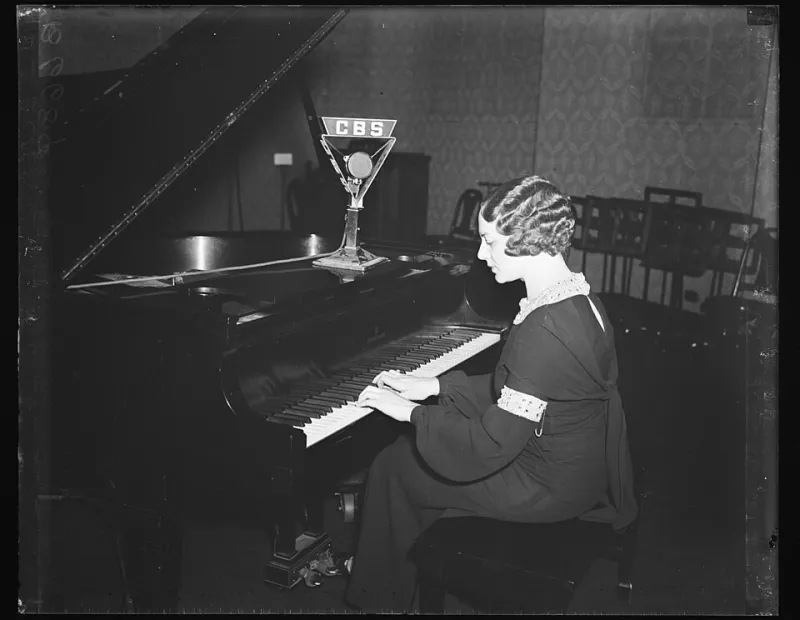
Photo: Harris & Ewing, photographer, Public domain, via Wikimedia Commons
Liên Phạm was thirty-four years old the first time she held a đàn tranh. She wasn't at a cultural festival or a heritage showcase. She was in a small studio apartment in Garden Grove, California, watching a YouTube tutorial on her laptop with the volume low so her roommate wouldn't hear her fumbling through the first lesson.
"I felt ridiculous," she laughs now. "I'm a software engineer. I hadn't touched an instrument since middle school recorder. But something about that sound — I don't know. It got into me."
That feeling — part recognition, part longing, part something that doesn't quite have a word in English — is drawing a growing number of Vietnamese Americans to traditional instruments in adulthood. Not as a career pivot or a performance ambition. More like a homecoming they didn't know they'd been waiting for.
The Instruments Nobody Taught Them
For many Vietnamese American kids who grew up in the '90s and early 2000s, the music of their parents' homeland arrived in fragments — a cassette tape playing in the background during Tết, a cải lương opera on a fuzzy TV channel, the sound of a grandmother singing softly in the kitchen. Traditional instruments like the đàn bầu (a single-string monochord with an otherworldly, bending tone), the đàn tranh (a sixteen-string zither), and the sáo trúc (bamboo flute) were present but distant. Beautiful, but not quite theirs.
School music programs offered piano, violin, guitar. Saturday Vietnamese school focused on language and history. The traditional arts often fell through the gap — preserved in memory but rarely passed down hand to hand.
Now, in their twenties, thirties, and forties, some Vietnamese Americans are circling back.
Minh Trần, who teaches đàn tranh at a community arts center in San Jose, has noticed the shift clearly over the last five years. His student roster, once made up mostly of recent immigrants and older community members, now includes a growing wave of American-born Vietnamese learners.
"They come in and they say, 'I don't know why I'm here, but I needed to be here,'" Minh says. "That's actually a pretty common first sentence. They can't always explain it rationally. They just feel pulled."
More Than Music Theory
What these adult learners are chasing isn't always musical mastery. For many, the instrument is a doorway.
Khánh Nguyễn, a nurse practitioner in Houston, started learning the sáo trúc after her mother was diagnosed with dementia. Watching her mother lose language, lose names, lose the thread of her own story sent Khánh into a kind of grief she couldn't process through ordinary channels.
"My mom used to hum these old southern Vietnamese melodies when she cooked. She couldn't tell me the names of the songs. She couldn't tell me much at the end," Khánh says quietly. "Learning the flute was my way of trying to hold onto what she was losing. Like if I could play the sounds she loved, some part of her was still there."
This kind of intergenerational reaching — using music to bridge a gap that words failed to close — comes up again and again in conversations with Vietnamese American learners. There's a particular grief that runs through the second generation: the grief of parents who were too busy surviving to teach, and children who were too busy assimilating to ask.
Traditional music, it turns out, holds some of what was never said out loud.
The Sound of a Vietnam They Never Visited
For some learners, the pull is less personal and more ancestral — a curiosity about a country they know mostly through family stories and summer vacation photographs.
Tony Lê, who grew up in suburban Atlanta and has visited Vietnam only twice, started learning the đàn bầu after stumbling across a performance video online at two in the morning.
"The sound just wrecked me," he says. "I sat there in the dark and cried and I didn't even know why. I'm a pretty logical person. I couldn't explain it. But I knew I had to learn that instrument."
The đàn bầu is famously difficult — its microtonal bends and overtones require a sensitivity that takes years to develop. Tony is still a beginner after eighteen months of practice. He doesn't care.
"It's not about being good. It's about the act of trying," he says. "Every time I practice, I feel like I'm having a conversation with my grandparents. Even though I never really knew them. Even though they're gone."
Minh Trần, the San Jose teacher, sees this often. "The instrument becomes a kind of time travel," he says. "My students aren't just learning scales. They're learning how to inhabit a part of themselves that got left behind."
Building Community One Lesson at a Time
The rise of online learning has made traditional Vietnamese music more accessible than ever before. YouTube channels, Vietnamese diaspora Facebook groups, and apps connecting students with teachers in Vietnam and the US have lowered the barrier to entry dramatically. Organizations like the Vietnamese Music Foundation and various community cultural centers across California, Texas, and Virginia have also expanded their adult programming in recent years.
But beyond logistics, something cultural is shifting. There's a growing sense among younger Vietnamese Americans that heritage isn't something you inherit passively — it's something you actively choose, build, and practice.
For Liên Phạm, the software engineer in Garden Grove, the đàn tranh has become a weekly ritual. She's not performing anywhere. She plays for herself, sometimes for her parents when she visits, sometimes for no one at all.
"My parents worked so hard so I could be American," she says. "And I am. But I'm also this other thing. And I needed a way to be that thing out loud."
The strings don't lie. When she plays, even imperfectly, something settles in her chest that nothing else quite reaches.
Maybe that's what belonging sounds like — not a perfect note, but the willingness to keep reaching for it.