What You Lost in Translation Was Never Really Gone

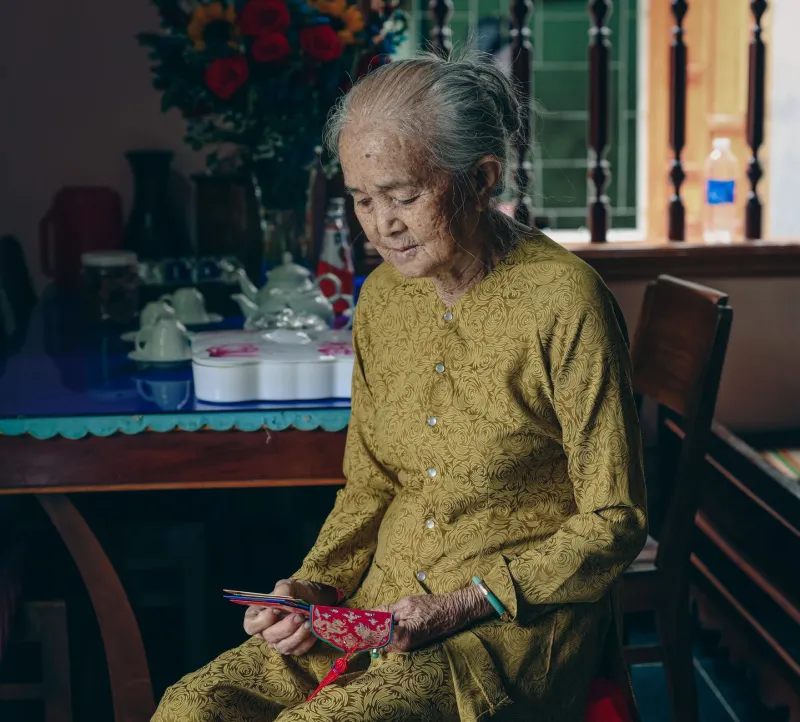
There's a specific kind of embarrassment that hits when your grandmother asks you something in Vietnamese and you smile and nod because you understood maybe three words. You fill in the rest with context clues and guesswork, the way you've always done. She keeps talking. You keep nodding. And somewhere inside, something small and familiar twists.
If you're Vietnamese American, you probably know that feeling by heart — even if you can't name it in Vietnamese.
Language loss is one of the most quietly painful experiences in the Vietnamese American community, and yet it almost never gets talked about directly. It lives in the space between generations, in the halted phone calls with relatives overseas, in the moment you reach for a word and find only air.
The Pressure That Shaped a Generation
Here's what gets left out of the conversation: the people who "lost" Vietnamese didn't misplace it carelessly. They were often pushed — by schools, by neighbors, by a survival instinct that said speak English or fall behind.
For families who arrived in the 1970s and 80s, assimilation wasn't a lifestyle choice. It was strategy. Parents who had already lost so much — homes, careers, entire social worlds — made calculated decisions to prioritize English fluency for their children. Some stopped speaking Vietnamese at home intentionally. Others simply worked too many hours to sit down and practice.
The kids absorbed English from teachers, from television, from the playground. Vietnamese stayed home, and even at home it started to shrink. By the time those kids became teenagers, they could understand enough to get by but speaking felt clunky, embarrassing, wrong. So they stopped.
This is the story of a generation. Maybe two.
When Heritage Becomes a Test You Didn't Know You Were Taking
The cruelest part of language loss isn't the loss itself — it's the judgment that follows.
Within Vietnamese communities, fluency can function as a kind of cultural passport. Speak it well and you're accepted as authentically Vietnamese. Struggle with it and suddenly your identity gets questioned, sometimes by strangers, sometimes by your own relatives. You forgot your language can sound an awful lot like you forgot who you are.
But this framing puts the blame in exactly the wrong place. Children don't control the environments they grow up in. They don't choose which language their school system validates. They don't decide whether their parents have the time and emotional bandwidth to sit down every evening and run through vocabulary.
And yet the guilt lands on them anyway. It's one of those inheritances nobody asked for.
The Body Remembers What the Mouth Forgets
Something interesting happens when Vietnamese Americans who've "lost" the language go back to Vietnam or sit in a room full of Vietnamese elders. The language often starts to come back — not fluently, not perfectly, but in fragments. A phrase surfaces. An old greeting returns. The ear tunes in faster than expected.
Language researchers have a term for this: language attrition doesn't erase a language so much as it buries it. The neural pathways are still there. They just need a reason to light up again.
This matters because it reframes what loss actually means. You didn't delete your Vietnamese. You archived it. And archives, with enough care and the right conditions, can be reopened.
Reclaiming Without Performing
There's a version of language reclamation that feels performative — the kind where you post your Vietnamese lessons on social media and treat fluency like a destination you're racing toward. That's fine if it works for you. But it's not the only path.
For some people, reclamation looks like calling a parent and just listening more carefully. It looks like watching Vietnamese dramas without subtitles, letting the rhythm of the language wash over you even when the meaning slips. It looks like asking your grandmother to tell you a story and recording it on your phone, not because you understand every word, but because you want to keep her voice.
Reclamation doesn't have to mean fluency. It can mean relationship. It can mean effort. It can mean simply deciding that the language matters to you, even imperfectly, even incompletely.
You Are Still Vietnamese
Here is the thing that needs to be said plainly: your Vietnamese identity does not live in your grammar.
It lives in the way you take off your shoes at the door. In the way you know, without being told, that you bring fruit when you visit someone's home. In the way certain smells — star anise, fish sauce, a particular kind of rain — reach something in you that English has no words for.
Language is one vessel for culture. It is not the only one.
The guilt you carry about the words you've lost is real and it deserves acknowledgment. But so does this: you are the product of people who survived extraordinary things so that you could stand where you stand today. The fact that you grew up speaking English fluently, that you moved through American systems with less friction than they did — that was often the point. That was what they wanted for you.
You didn't betray your heritage by living the life they built for you.
Maybe the journey back to Vietnamese — however far you take it — is its own kind of tribute. Not to prove something. Not to pass a test. But because some part of you is still listening for the words that were always yours.