Little Saigons Worth the Detour: A Road Map to Vietnamese America
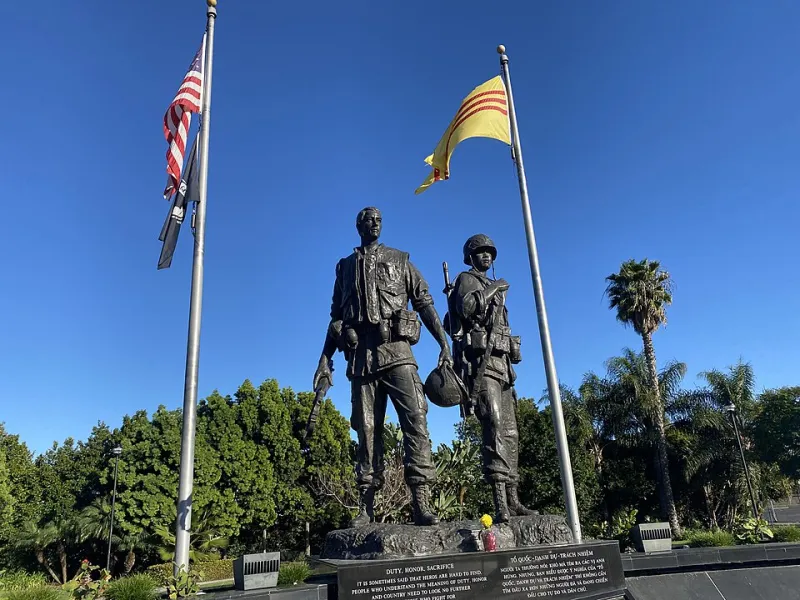
Photo: Jeremy Nguyen , CC BY-SA 4.0, via Wikimedia Commons
You do not need a passport to find Vietnam in America. You need a car, a free weekend, and the willingness to leave the interstate. Vietnamese American enclaves are not theme parks or single restaurants. They are neighborhoods with their own rhythms: early markets, bakery windows, salon chairs, memorials, church parking lots, and phở shops that open before the sun.
This is not a replacement for going back. It is a different kind of travel — one that follows migration waves, storefronts, and the everyday rituals that Vietnamese Americans built in plain sight.
Westminster, California: The First Stop for a Reason
Start on Bolsa Avenue. Westminster and neighboring Garden Grove make up the heart of Little Saigon in Orange County, one of the largest Vietnamese communities outside Vietnam. The strip is not subtle. You will see Vietnamese on signs, hear it in line, and smell grilled pork before you see the source.
Walk through a market. Buy a bag of oranges you did not plan to buy. Watch the produce section become a conversation. Stop for a bánh mì, then a coffee. The area carries the weight of the first major wave of refugees after 1975, and later arrivals layered on top. Some storefronts look old. Some look new. The point is not to find the most authentic one. The point is to notice how many versions of home fit on the same road.
San Jose: The Other Capital
San Jose is not a sequel to Orange County. It is its own capital. The Story Road area and Grand Century Mall draw families from across the South Bay, and the crowd tells you a lot: grandparents in cardigans, tech workers on lunch breaks, teenagers who speak English with each other and Vietnamese with their grandmothers.
This is a good place to slow down. Get a table at a coffee shop and listen. You will hear three generations in one booth. You will see a family split a plate of fruit and argue about who pays. You will see the Vietnamese American future and the Vietnamese American past sharing a parking lot.
Houston: A Constellation, Not a District
Houston does not do compact. Its Vietnamese community spreads across Bellaire, Chinatown, and surrounding suburbs, so it feels less like a single neighborhood and more like a constellation. Hong Kong City Mall and the surrounding strip centers are a good anchor, but the real texture is in the smaller places: the bakery, the herbal shop, the restaurant where the server remembers a regular’s order.
Houston also shows how Vietnamese America keeps rebuilding. After hurricanes and floods, community networks kick in. Churches, temples, mutual aid groups, and family chats do what government forms cannot always do. Travelers can feel that resilience in the way a neighborhood returns after a storm — not untouched, but still there.
New Orleans East and the Gulf Coast
The Gulf Coast tells a different Vietnamese American story, one tied to water. In New Orleans East, Vietnamese families built lives around fishing, churches, and community after 1975. Hurricane Katrina devastated the area, and the recovery became a test of belonging. Mary Queen of Vietnam Church became a landmark not just for faith but for organizing.
Drive farther along the Gulf Coast and you find smaller communities tied to shrimping and fishing, including in places like Bayou La Batre, Alabama. This is not a scenic detour for the sake of scenery. It is a reminder that Vietnamese America is not only urban and not only West Coast. It is also boats, docks, and the risk of weather.
Northern Virginia and Seattle: The Bonus Stops
If you have more time, Eden Center in Falls Church, Virginia, is a shopping center that functions like a town square. In Seattle, the Rainier Valley holds a newer Vietnamese American layer, with coffee shops and restaurants that speak to a younger generation.
These stops are not boxes to check. They are places where people live. That distinction matters.
How to Travel Respectfully
Go to the market with a list, not just a camera. Ask before photographing people. Visit memorials quietly. Do not treat a neighborhood as a backdrop for your family-history essay. Spend money at small businesses, tip well, and leave the parking lot the way you found it.
And do not expect any Little Saigon to explain all of Vietnam. It cannot. It is not supposed to. It is a Vietnamese American place — shaped by refugees, immigrants, children, and the ordinary work of keeping a culture alive in a new country.
That is the road trip. Not a search for the realest phở. A drive through the Vietnams hiding in plain sight.