You Did Good, But We Don't Say That: The Quiet Ache of Vietnamese American Praise
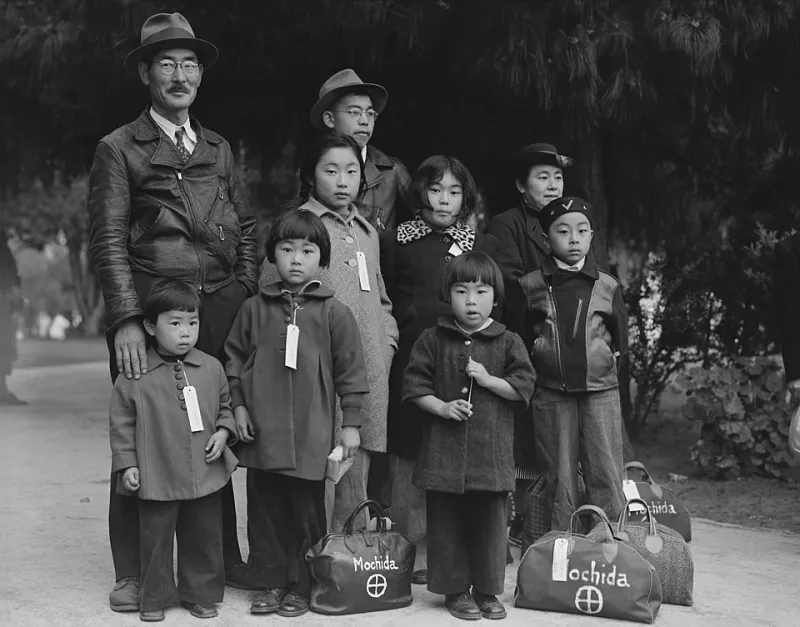
Photo: Dorothea Lange, Public domain, via Wikimedia Commons
The day Linh Nguyen walked across the stage to accept her medical degree, she scanned the crowd for her parents. She found them — her mother clutching a small purse, her father sitting perfectly straight in his folding chair. They were there. They had driven four hours from Houston to be there. And when it was over, when the cap and gown came off and the photos were taken, her father looked at her and said, "Make sure you study for your boards."
That was it.
No hug. No "I'm so proud of you." No acknowledgment that this moment — this specific, hard-won, decade-in-the-making moment — was anything more than a checkpoint on a longer road they had already mentally moved past.
"I cried in the bathroom," Linh told me. "Not because I was sad, exactly. I just didn't know what I had expected. I should have known."
She should have known. And yet, most of us never stop hoping.
The Push That Never Comes With a Finish Line
There is a particular kind of exhaustion that comes from being raised in a Vietnamese American household where achievement is expected, demanded even, but almost never celebrated. The pressure to perform is constant and loud. The recognition, when it comes at all, arrives in whispers — or not at all.
For many first- and second-generation Vietnamese Americans, this dynamic is so familiar it barely registers anymore. Parents who sacrificed everything — who crossed oceans, rebuilt lives from zero, worked double shifts and night jobs — poured that energy into a single, burning directive: do better than us. And yet, when their children actually do, the response is often a shrug, a pivot to the next goal, or an ominous silence that feels less like contentment and more like superstition.
Because for a lot of Vietnamese parents, it is exactly that.
Don't Brag. The Universe Is Listening.
There's a thread of belief woven through Vietnamese culture — rooted in a mix of Buddhist thought, Confucian restraint, and hard-lived experience — that celebrating too loudly invites misfortune. Kiêu ngạo, or arrogance, is considered not just a character flaw but a kind of spiritual liability. To praise your child too openly, too effusively, is to wave a red flag at whatever forces might be waiting to take it all away.
For parents who watched entire lives collapse — who fled war, lost homes, buried people — this isn't superstition. It's pattern recognition. The universe has already proven it can take things. Why tempt it?
And so they hold back. Not out of coldness. Out of love that has learned, through grief, to protect itself.
Thuan Pham, a software engineer in San Jose, grew up watching his parents react to every good grade, every award, every small victory with the same measured nod. "My mom would say 'ừ, tốt' — like, 'yeah, good' — and that was it. I used to think she didn't care. Now I think she was terrified to care too much out loud."
When Survival Mode Doesn't Have an Off Switch
There's another layer here that goes beyond superstition. Many Vietnamese immigrant parents spent formative years in a mode of pure survival — where the only question worth asking was how do we get through this? Celebration, in that context, is a luxury. You don't stop to admire the view when you're still climbing.
The problem is that for some parents, survival mode never fully switches off. Even when the danger is gone, even when the children are safe and thriving in ways the parents could not have imagined, the emotional circuitry stays wired for endurance rather than joy.
Dr. Michelle Tran, a therapist based in Orange County who works primarily with Asian American clients, sees this pattern constantly. "What I hear from a lot of my Vietnamese American clients is this sense of emotional abandonment at the moment they expected connection the most," she said. "Their parents showed up physically — to graduations, to ceremonies. But emotionally, there's a wall. And the child interprets that wall as I'm still not enough."
The cruel irony is that the parents often have no idea. In their minds, showing up is the celebration. Paying for the tuition is the acknowledgment. The love was always there — it was just expressed in a language their children were never taught to read.
The Grammar of a Different Kind of Love
There's a phrase that floats around in Vietnamese American spaces, online and off: "My parents never said I love you, but they always made sure I ate." It's become almost a cliché, but it points to something real — the idea that love in many Vietnamese households is transactional not in a cynical way, but in a deeply practical one. It shows up as action, as provision, as sacrifice. Rarely as words.
For children raised in America, surrounded by a culture that prizes verbal affirmation — where "good job" and "I'm proud of you" are considered basic emotional nutrition — this mismatch creates a kind of chronic hunger. You were fed. You were clothed. You were pushed and supported and carried. But you were also, in a very specific way, starving.
Mai Le, a teacher in the Bay Area, described it like this: "I used to make honor roll every semester. And every semester, my dad would take the report card, look at it, and put it on the counter. That was it. I'd stand there waiting. I don't know what I was waiting for. I'm still kind of waiting."
What We Do With the Silence
Some Vietnamese Americans have found ways to reframe the silence — to read it not as withholding but as a different dialect of care. Others have had direct conversations with their parents, sometimes years later, and discovered that their parents did feel pride, enormous pride, but simply had no model for expressing it.
Still others carry the wound forward, sometimes replicating the same dynamic with their own children without realizing it, sometimes overcorrecting in ways that feel foreign and awkward.
What almost all of them share is the moment — usually in their twenties or thirties — when they finally understand that their parents' silence was never about them. It was about survival. About fear. About a culture that taught restraint as virtue and endurance as love.
That understanding doesn't always heal the ache. But it changes its shape.
A Different Kind of Arrival
Hành trình — the journey — is never just about where you end up. It's about what you carry along the way, and what you finally learn to set down.
For many Vietnamese Americans, part of that journey is learning to celebrate themselves, loudly and without apology, in the spaces where their parents could not. To say I did this and mean it. To throw the party, make the speech, post the photo.
And maybe, quietly, to know that somewhere in the row behind them, a parent is sitting perfectly straight, clutching a small purse, proud in a language that was never written down.